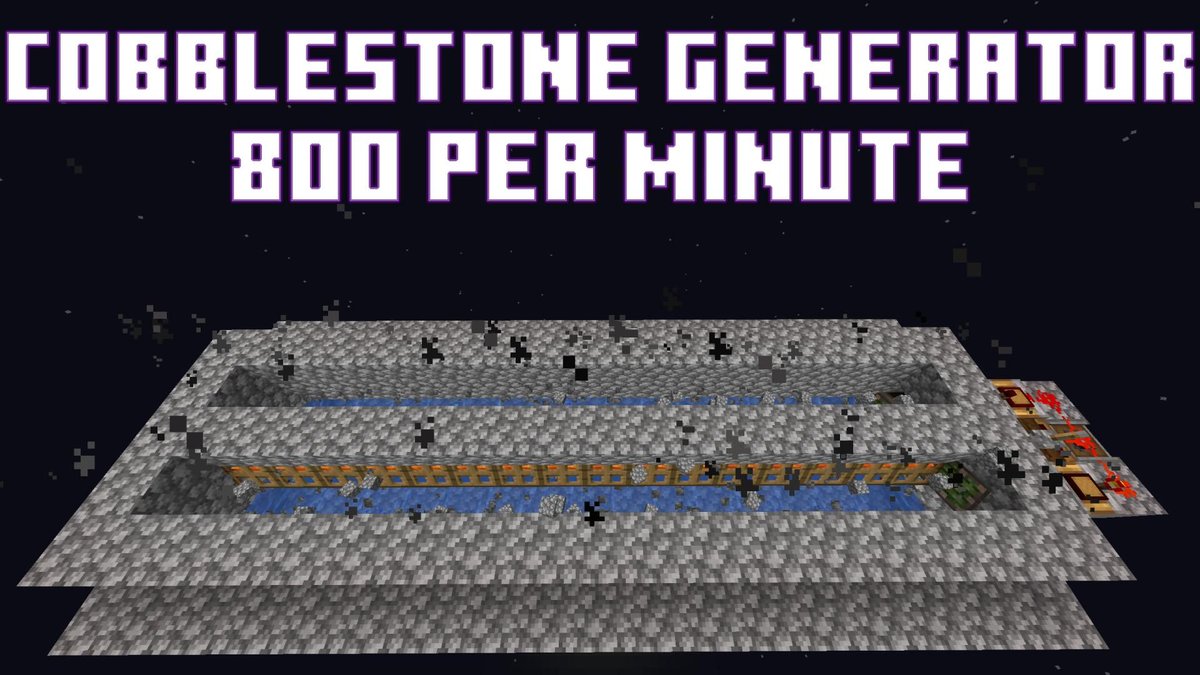
Minecraft is a world of endless possibilities, but even in this blocky paradise, some resources are finite. That’s where the ingenious cobblestone generator comes in, transforming scarce materials into an unlimited supply of one of the game's most fundamental building blocks. Whether you're a seasoned crafter or just starting your first survival world, understanding how to build one of these contraptions is a game-changer, especially for challenging maps like Skyblock where resources are minimal.
This guide will walk you through everything you need to know, from the core mechanics to advanced automated designs, ensuring you'll never run out of cobblestone again. Get ready to expand your builds, craft powerful tools, and fuel your furnaces with an endless stream of this versatile stone!
Why You Need an Unlimited Supply of Cobblestone
Cobblestone isn't just common; it's the backbone of countless crafting recipes and construction projects in Minecraft. From basic tools and furnaces to elaborate castles and fortified bases, cobblestone is constantly in demand. Relying solely on mining can quickly deplete local stone reserves and become a tedious chore. A well-designed cobblestone generator eliminates this bottleneck, providing a renewable source that allows you to focus on exploration, building, and adventure without worrying about your block count.
The magic behind these generators is elegantly simple: the interaction between flowing lava and flowing water. When these two liquids meet under specific conditions, they create new blocks. Most commonly, this interaction yields cobblestone, but different setups can produce stone or even obsidian. Understanding these interactions is key to building a successful generator, and we dive deep into the precise configurations in our guide on Basic cobblestone generator designs.
Getting Started: The Fundamental Mechanics of Cobblestone Generation
At its heart, a cobblestone generator exploits a fundamental game mechanic: when flowing lava touches flowing water, it creates a cobblestone block. If flowing water touches still lava, it creates obsidian. Conversely, if flowing lava touches still water, it produces a regular stone block. To build any successful generator, you only need a single water source block and a single lava source block – the minimal resources that can sustain an infinite supply.
Before diving into complex designs, it's crucial to gather the right items. You’ll definitely need buckets for water and lava, along with some solid, inflammable blocks for containment. Depending on your chosen design, tools like pickaxes (preferably enchanted with Fortune for more cobblestone!), and Redstone components might also be necessary. For a comprehensive checklist of everything you'll need, refer to our detailed article on Essential Construction Materials & Tools.
Simple Cobblestone Generator: The Skyblock Essential
This is the easiest generator to build, perfect for survival spawns with limited resources, especially on Skyblock maps where every block counts. It requires minimal setup and only one water and one lava bucket.
- Preparation: Dig a 4-block long, 1-block wide, 1-block deep trench.
- Deepen a Section: Break the second block from one end, making that specific section 2 blocks deep.
- Place Water: Put your water source in the end of the trench closest to the deeper hole. This will make the water flow into the deeper section.
- Place Lava: Place your lava source at the opposite end, two blocks away from the deeper hole.
- Generate! Cobblestone will continuously form in the middle block, ready for you to mine.
The Popular Choice: Efficient Design with Collection
Many players opt for a slightly more advanced design that incorporates a basic collection system, making it more efficient than the simple trench. This design often uses stairs to help direct water flow and prevent unwanted obsidian generation.
- Collection Setup: Start by placing a double chest in the ground, then connect five hoppers, with one facing directly into the chest.
- Containment: Enclose the hoppers and chest with sturdy, inflammable solid blocks.
- Water Flow: Place five stairs on top of the solid blocks surrounding the hoppers, and then waterlog them to create a continuous water flow.
- Lava Placement: Position a layer of solid blocks above the bottom ones and place a sign at head level above the chest. Then, add a third layer of solid blocks above the stairs and sign, creating a trough for the lava.
- Final Step: Place a lava bucket one block above the flowing water, centered over where the stairs are. This setup will generate stone blocks that flow directly into your collection system when mined. Use a Fortune-enchanted pickaxe to maximize cobblestone yield.
Stepping Up: Piston Power and Automation
For those seeking more consistent production or hands-free operation, Redstone mechanisms come into play. Pistons can push generated blocks, allowing for larger cobblestone "walls" to form, while fully automated systems can break and collect blocks without any player intervention.
Piston-Based Cobblestone Generator: Reliable Production
Piston-powered generators offer a reliable method to create a continuous line of cobblestone that can be mined more efficiently. They use Redstone to push blocks towards you, preventing them from floating away or getting destroyed by lava.
- Water Containment: Place five inflammable stairs, surround them with solid blocks, and waterlog the stairs to create a water source.
- Lava & Piston Prep: Place solid blocks on top of the stairs and along the edges. Extend two blocks on either end and connect these ends with more solid blocks to form a lava holding area.
- Redstone Torch & Piston: Break a block diagonally downwards from a stair on one side and place a Redstone Torch in the hole. Place a Piston diagonally upwards from this torch, facing it.
- Piston Line: Attach a solid block to this first piston and place one Redstone Dust next to it. Then, place a row of eight pistons attached to the opposite side of the first piston, with solid blocks behind them topped with Redstone Dust.
- Circuitry: Break a block diagonally downwards from the last piston and place another Redstone Torch. From this torch, add two Redstone Dust, followed by a Redstone Repeater, then two more Redstone Dust, connecting to the Redstone Dust behind the main piston line.
- Lava & Activation: Place your lava source one block above the first piston, in the center of the ring. Finally, place a lever on the solid block attached to the first piston to activate or deactivate your reliable cobblestone production line.
The Ultimate Farm: Fully Automated Cobblestone Generator
For the true Minecraft master, a fully automated cobblestone generator is the pinnacle of efficiency. These complex builds often integrate TNT dupers and elaborate collection systems, generating hundreds of thousands of blocks per hour while you're off exploring or building other projects. They are heavily resource-intensive but deliver unparalleled yields.
These sophisticated designs typically involve several core components:
- A robust Generator section with pistons and observers to detect and pull newly formed cobblestone.
- A precise TNT Duper that infinitely creates and drops TNT to break the blocks.
- An Etho Hopper Clock or similar Redstone circuit to power the TNT duper at timed intervals.
- An efficient Collection System that uses water flows and hoppers to funnel all generated items into chests.
While incredibly powerful, fully automated farms require careful construction and understanding of complex Redstone mechanics. They can also malfunction if not built correctly, potentially deleting your lava source if pistons reach their push limit without proper safeguards. Diving into the intricacies of these builds is a journey in itself, and you can learn how to construct these magnificent machines and their various Redstone components in our dedicated guide to Advanced & Automated Cobblestone Generator.
Unlocking the Full Potential: Benefits and Practical Uses
Beyond just being a building material, cobblestone serves a multitude of practical purposes in Minecraft. From crafting essential tools like pickaxes and hoes to constructing furnaces, brewing stands, and even creating experience farms, cobblestone is a cornerstone of survival. Its abundance, thanks to your new generator, means you can craft without reservation, build grander structures, and power more industrial-scale projects.
Having an unlimited supply also frees you from the mundane task of constantly mining, allowing you to focus on the more exciting aspects of the game. Whether you're filling large areas for terraforming, crafting an army of stone tools, or simply building a massive base, the benefits of a cobblestone generator are truly expansive. Explore the full range of possibilities and discover how this humble block can transform your gameplay in our article covering the Benefits & Practical Uses of.
Common Questions & Troubleshooting Your Generator
Even the simplest designs can sometimes act up. Here are answers to some common questions and issues you might encounter:
- Which design is best? For passive, background generation and collection, the fully automated design is unparalleled despite its cost. For starting out or Skyblock, the simple design is essential.
- Why am I getting obsidian instead of cobblestone? This usually happens when flowing water touches still lava. Ensure the specific spot where the water and lava interact to form cobblestone is two blocks deep, not one, allowing the lava to flow before interacting.
- What are the basic requirements? A minimum 4x1 flat area, one water bucket, and one lava bucket. That's it for the simplest version!
- Can I expand my generator? Absolutely! You can extend the water and lava trenches to generate multiple cobblestone blocks simultaneously. For automatic collection, place hoppers and chests underneath. For automatic mining, you'd typically need an auto-clicker or integrate a TNT duper as seen in advanced designs.
Encountering issues like your lava disappearing, water flowing incorrectly, or blocks turning into obsidian can be frustrating. Thankfully, most problems have straightforward solutions. If your generator isn't behaving as expected, don't worry – our comprehensive guide will help you Troubleshoot generator problems Fix cobblestone generator and get your block production back on track.
Mastering the art of the cobblestone generator is a fundamental step towards thriving in any Minecraft world. From simple beginnings to complex automated factories, the ability to create an endless supply of blocks will fuel your creativity and bolster your survival. Experiment with different designs, adapt them to your needs, and enjoy the limitless possibilities that an infinite supply of cobblestone brings to your adventures!